


Views: 0 Author: Site Editor Publish Time: 2026-04-17 Origin: Site


Did you know that the number of valence electrons in aluminum directly impacts its reactivity? Aluminum, with its unique properties like lightness and resistance to corrosion, is a versatile element in numerous applications. In this article, we will explore how many valence electrons aluminum has and why this plays a crucial role in its behavior during chemical reactions. You’ll also discover how this knowledge shapes its use in industries ranging from manufacturing to construction.
Valence electrons are the electrons found in the outermost shell or energy level of an atom. These electrons are crucial because they are the ones involved in chemical reactions, bond formation, and interactions between atoms. Since they are located farthest from the nucleus, they experience less pull from the atom's positively charged center, making them more readily available for bonding. In simple terms, valence electrons determine how an element will react with others and are central to its ability to form bonds—either by sharing, gaining, or losing electrons.
Valence electrons play a fundamental role in the chemical behavior of an element. The number of valence electrons in an atom determines its reactivity and the types of chemical bonds it can form. For instance, elements with a full outer shell, like noble gases, tend to be non-reactive, while elements with one or two valence electrons, like aluminum, are more likely to lose those electrons in reactions. This behavior allows aluminum to form stable compounds, such as aluminum oxide (Al₂O₃) and aluminum chloride (AlCl₃), by donating its valence electrons. Essentially, the valence electrons define the element’s place in the periodic table, its bonding patterns, and its overall chemical properties.
Aluminum has an atomic number of 13, which means it has 13 protons in its nucleus and, in its neutral state, 13 electrons surrounding the nucleus. These electrons are distributed in energy levels or shells, following the principle of least energy. According to this principle, electrons fill the lowest energy levels first before occupying higher levels. The first energy level, closest to the nucleus, can hold up to 2 electrons, while the second can hold 8 electrons. The third energy level, where aluminum’s valence electrons are found, can hold up to 18 electrons, but in the case of aluminum, it contains 3 electrons. The electron configuration of aluminum is written as 1s² 2s² 2p⁶ 3s² 3p¹, with the first two shells filled completely (2 electrons in the first shell and 8 in the second shell). The third shell, which is the valence shell, contains 3 electrons. These 3 electrons are key to aluminum's chemical reactivity, as they are the ones involved in bond formation.
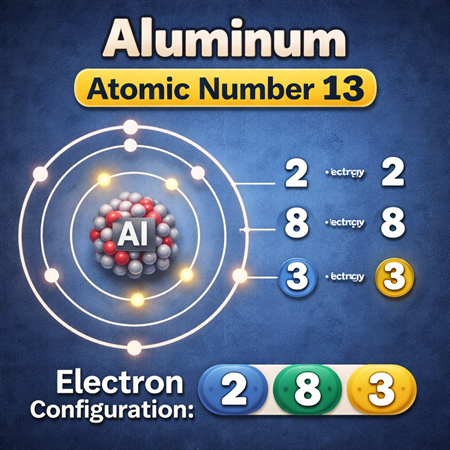
Aluminum’s 13 electrons are arranged in three energy levels or shells. The first shell (1s²) holds 2 electrons, the second shell (2s² 2p⁶) holds 8 electrons, and the third shell (3s² 3p¹) contains the remaining 3 electrons. The third shell is known as the valence shell, as it holds the electrons that are most likely to participate in chemical reactions. In aluminum, the third shell contains 2 electrons in the 3s orbital and 1 electron in the 3p orbital. These 3 electrons are the valence electrons, which are critical in determining how aluminum reacts with other elements. They are the farthest from the nucleus and, therefore, are less tightly bound, making them more accessible for chemical bonding.
Aluminum has 3 valence electrons located in its third energy level (n=3). These electrons reside in the 3s orbital, which holds 2 electrons, and the 3p orbital, which holds 1 electron. The valence electrons are the outermost electrons of an atom, and they are the primary participants in chemical bonding. Because these electrons are the farthest from the nucleus, they experience less pull from the protons in the nucleus, making them more likely to interact with other atoms. This ability to interact with other elements is what makes aluminum highly reactive and capable of forming a variety of compounds. The number and arrangement of these valence electrons determine aluminum’s chemical behavior and its ability to form ionic and covalent bonds.
The 3 valence electrons in aluminum are crucial to its chemical reactivity and its role in bonding. Aluminum tends to lose these 3 electrons when it reacts with other elements, forming an Al³⁺ ion, which has a stable electron configuration similar to the noble gas neon. This electron loss occurs easily because the 3 valence electrons are not strongly held by the nucleus. When aluminum reacts with nonmetals such as chlorine or oxygen, it typically donates its 3 valence electrons, allowing it to form ionic compounds such as aluminum chloride (AlCl₃) and aluminum oxide (Al₂O₃). In ionic bonding, aluminum gives up its electrons to form positively charged ions, which then attract negatively charged ions. In addition to ionic bonding, aluminum can also engage in covalent bonding, where it shares its valence electrons with other atoms. This versatility in bonding enables aluminum to participate in a wide range of chemical reactions and makes it useful in various industrial applications. The presence and behavior of aluminum’s 3 valence electrons are therefore central to its chemistry, including its ability to form durable compounds, conduct electricity, and withstand harsh environmental conditions.
Aluminum has 3 valence electrons in its outermost shell, and this electron configuration makes it highly reactive. To achieve a more stable electron configuration, similar to that of the noble gas neon, aluminum tends to lose these 3 electrons during chemical reactions. This results in the formation of an Al³⁺ ion, a positively charged particle with a full outer electron shell. The loss of electrons enables aluminum to bond easily with other elements, particularly nonmetals like oxygen and chlorine, forming stable ionic compounds.
This characteristic is a fundamental feature of aluminum, making it one of the most reactive metals, particularly in the presence of halogens and oxygen. Aluminum’s ability to lose its 3 valence electrons so readily is what drives its chemical behavior and makes it essential for numerous industrial applications, including manufacturing, material coatings, and chemical reactions in a wide variety of settings. Its behavior is central to aluminum’s widespread use in creating durable, high-performance products, such as aluminum-based alloys and coatings that resist corrosion.
Element | Electron Configuration | Electrons Lost | Ion Formed | Stability of Ion |
Aluminum | 1s² 2s² 2p⁶ 3s² 3p¹ | 3 | Al³⁺ | Stable |
Sodium | 1s² 2s² 2p⁶ 3s¹ | 1 | Na⁺ | Stable |
Magnesium | 1s² 2s² 2p⁶ 3s² | 2 | Mg²⁺ | Stable |
The loss of its 3 valence electrons makes aluminum particularly adept at forming ionic compounds in several key reactions. One of the most common reactions involving aluminum is its combination with chlorine to form aluminum chloride (AlCl₃). In this reaction, aluminum gives up its 3 valence electrons, which are accepted by chlorine atoms. This results in the formation of Al³⁺ and Cl⁻ ions, which then combine to create aluminum chloride. Aluminum chloride is a widely used compound in industrial processes such as water treatment and as a catalyst in chemical reactions.
Another significant reaction is the formation of aluminum oxide (Al₂O₃), which occurs when aluminum reacts with oxygen in the air. During this reaction, aluminum loses its 3 valence electrons, resulting in the formation of Al³⁺ ions. The oxygen atoms accept electrons, forming O²⁻ ions. These ions bond together to form aluminum oxide, a compound that naturally forms a thin, protective layer on the surface of aluminum. This oxide layer serves as a barrier against further oxidation, making aluminum highly resistant to corrosion and ideal for use in outdoor environments or in applications requiring long-term durability. The formation of aluminum oxide is a direct consequence of aluminum's valence electrons and their ability to interact with oxygen, protecting the material in harsh conditions.
Reaction | Reactants | Products | Bond Type | Resulting Compound |
Aluminum reacts with chlorine | Al + Cl₂ | AlCl₃ | Ionic | Aluminum chloride |
Aluminum reacts with oxygen | Al + O₂ | Al₂O₃ | Ionic/Covalent | Aluminum oxide |
These reactions highlight how aluminum’s valence electrons are crucial not only in its ability to form stable ionic compounds but also in the creation of protective coatings, making aluminum a versatile and vital element in a variety of chemical processes and industrial applications.
The 3 valence electrons in aluminum play a critical role in its chemical and physical properties, especially its lightweight nature and resistance to corrosion. Aluminum readily loses its valence electrons, forming Al³⁺ ions, which allows it to bond with oxygen to create a thin but protective oxide layer on its surface. This oxide layer shields the underlying metal from further oxidation and corrosion, making aluminum highly durable in a variety of environments, including those exposed to moisture or air. The ease with which aluminum loses electrons also contributes to its low density, making it a lightweight material ideal for industries like aviation, automotive manufacturing, and construction, where both strength and weight are crucial factors.

Aluminum's ability to lose its 3 valence electrons also enables extensive customization in the production of aluminum profiles, such as aluminum fence or aluminum pergola. These profiles can be tailored to meet specific needs like strength, appearance, and corrosion resistance by altering factors such as alloy composition, surface treatment, and thickness. For example, aluminum fences can be designed to be both strong and aesthetically pleasing, while aluminum pergolas can be customized to endure outdoor conditions and resist the elements. The versatility of aluminum, combined with its chemical properties, allows manufacturers to produce a wide range of products with varying characteristics, making it adaptable to the specific requirements of different industries like construction, transportation, and outdoor design.
Aluminum's 3 valence electrons are crucial to its chemical behavior and versatility. This electron configuration allows aluminum to form stable bonds, making it essential in various industrial applications. Understanding these valence electrons is key to appreciating aluminum’s wide-ranging uses. Products like aluminum curtain walls, industrial aluminum profiles, and aluminum radiators highlight its strength and durability. Foshan Newsky Aluminum Co., Ltd. provides high-quality aluminum profiles, offering customization and ensuring that their products meet diverse industry needs, from construction to industrial uses.
A: Aluminum has 3 valence electrons, which are crucial for its chemical reactivity and bonding ability. This characteristic makes aluminum versatile for applications in industries like construction, automotive, and electronics.
A: The 3 valence electrons in aluminum contribute to the formation of a protective oxide layer, which significantly enhances its corrosion resistance, making it ideal for long-lasting products like aluminum profiles and aluminum radiators.
A: Understanding aluminum’s 3 valence electrons helps engineers select the right material for applications requiring lightweight, durable, and corrosion-resistant components, such as in industrial aluminum profiles and aluminum curtain walls.
A: The loss of aluminum’s 3 valence electrons allows it to form Al³⁺ ions, which makes aluminum highly reactive and suitable for use in chemical reactions like forming aluminum chloride and aluminum oxide.
A: Aluminum's 3 valence electrons make it highly reactive, allowing it to form stable bonds with other elements, especially in applications like aluminum profiles and aluminum radiators.
