


Views: 0 Author: Site Editor Publish Time: 2026-06-05 Origin: Site


High-power LED systems and modern electronics convert over 50% of their input power directly into heat. Without active or passive thermal management, silicon degrades rapidly at critical thresholds like 200°C. This excessive thermal stress inevitably leads to catastrophic system failure. For engineers and procurement teams, specifying a heat sink is no longer an afterthought. It is a critical component. A well-designed cooling solution dictates hardware lifespan, ensures operational stability, and maintains energy efficiency over time. This guide breaks down the core engineering principles, manufacturing trade-offs, and procurement criteria you need. You will learn how to specify the optimal aluminum heat sink profile for high-density thermal applications. We will explore alloy selection, structural design rules, and essential vendor evaluation metrics to ensure long-term reliability.
Thermal Impact: Every 10ºC rise in LED junction temperature reduces operational lifespan by 30-50% and causes a 1-nanometer color shift (yellowing).
Material Efficiency: Standard heat sink aluminum (like 6000-series alloys) provides an optimal balance of thermal conductivity (180–215 W/mK), weight reduction, and cost-effectiveness compared to copper.
Design Rule of Thumb: Passive cooling generally requires 3 square inches of exposed heat sink surface area per watt of heat dissipated.
Manufacturing Selection: Aluminum extrusion remains the industry standard for linear cooling, while cold forging and skiving offer higher fin density for space-constrained electronics.
Overheating wreaks havoc on sensitive electronic components. You cannot ignore the physics of heat generation in modern circuitry. In computing and power electronics, thermal throttling kicks in when CPUs or GPUs hit thermal limits. The system deliberately drops clock speeds to prevent the silicon from melting. This throttling severely reduces hardware performance. In LED systems, poor heat management causes non-radiative recombination. The electrical energy intended to create light instead generates even more heat. This phenomenon starts a vicious cycle of degradation. You will see severe lumen depreciation and a noticeable forward voltage drop over time.
Many engineers wonder why they should choose aluminum over other metals. Copper conducts heat extremely well. Pure copper achieves a thermal conductivity of roughly 400 W/mK. However, aluminum alloys range between 90 and 240 W/mK. Despite copper's superior thermal transfer rate, it carries major disadvantages. Copper weighs nearly three times as much as aluminum. It also costs significantly more. Aluminum offers a much lighter weight and a drastically lower raw material cost. Furthermore, a natural oxide layer gives aluminum excellent corrosion resistance out of the box. This perfect balance of cost, weight, and performance makes thermal aluminum the undisputed commercial standard for mass production.
Engineers rely on strict baselines when designing LED systems. Active thermal management becomes mandatory when LED driver currents hit 350mA. Beyond this 350mA threshold, natural ambient cooling simply fails to protect the diode junction. You need a dedicated, properly engineered cooling profile to pull heat away from the source safely.
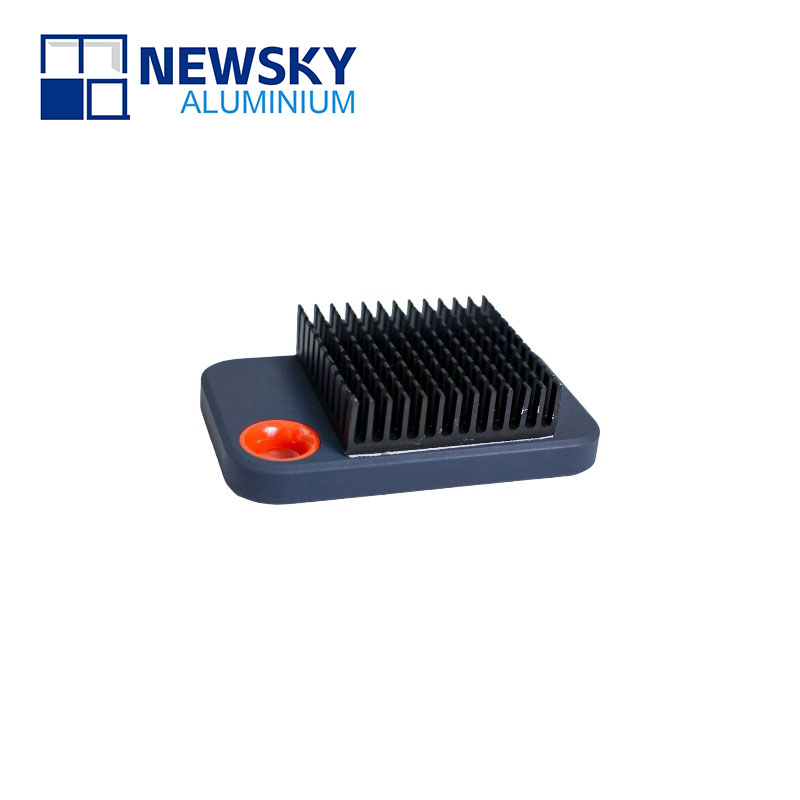
Not all thermal management components are manufactured equally. The production process you choose directly dictates cooling efficiency, structural scalability, and part cost. Different applications require entirely different manufacturing approaches.
Extrusion serves as the gold standard for linear designs. An aluminum extrusion heatsink achieves excellent thermal conductivity, usually ranging from 200 to 215 W/mK. This method forces heated aluminum billets through a steel die. The process creates continuous shapes and eliminates internal air porosity entirely. Extrusion works best for linear LED lighting, continuous architectural lighting runs, and cost-effective scaling.
Cold forging presents another highly efficient option. This process compresses the metal at room temperature, creating a highly dense grain structure. This process yields up to 15% better thermal performance than standard extrusion. It also beats die casting thermal performance by roughly 80%. Cold forging is ideal for high-power spot cooling and round LED arrays, commonly known as COB (Chip on Board).
Skived fin technology offers extreme fin density for tight spaces. Manufacturers use special cutting tools to slice thin fins directly from a solid aluminum block. They fold these slices upright to form the fins. This eliminates any thermal interface resistance between the base plate and the fins. Skiving works beautifully for space-constrained telecom equipment, server racks, or compact computer hardware.
Die casting allows engineers to create highly complex, non-linear shapes. Manufacturers inject molten metal into a mold under high pressure. However, this process requires adding silicon to improve the liquid metal's mold flow. This addition lowers thermal conductivity significantly. For example, the common ADC12 alloy offers only about 96 W/mK. Die casting also carries a distinct implementation risk. The process requires thicker fins to prevent structural failure. This limitation reduces the overall surface area compared to extruded alternatives.
Manufacturing Process | Typical Thermal Conductivity | Best Use Case | Primary Limitation |
|---|---|---|---|
Extrusion | 200 - 215 W/mK | Linear LED lighting, high-volume scaling | Limited to 2D continuous cross-sections |
Cold Forging | ~220 W/mK | High-power spot cooling, COB LEDs | Higher tooling costs, limited shape height |
Skived Fin | 200 - 215 W/mK | Servers, space-constrained electronics | Slow manufacturing speed, higher unit cost |
Die Casting | ~96 W/mK | Complex, highly integrated housings | Lower thermal conductivity, thicker fins |
Designing a precision aluminum profile requires careful geometric planning. You must balance surface area, airflow dynamics, and thermal radiation. A minor design flaw can trap heat and destroy sensitive electronics rapidly.
You must maximize surface area based on your expected thermal load. Engineers often rely on the 3-square-inch rule as a starting point. Passive convection generally requires 3 square inches of exposed surface area for every watt of heat dissipated. You use this baseline rule to calculate boundary requirements before sketching the fin layout. If a component generates 50 watts of heat, you need roughly 150 square inches of cooling surface.
Fin geometry heavily influences airflow behavior. Linear spread fin arrays work very well for directional forced air. Radial finned styles suit omnidirectional or natural convection setups better. However, over-densifying fins carries a massive implementation risk. Packing fins too tightly creates stagnant air pockets. The boundary layers of air overlap and kill natural convection. To solve this, designers utilize cross-cut patterns. These strategic cuts break up air boundaries and improve turbulent flow. Furthermore, there is a strong trend toward aerodynamic designs. Smooth, widely spaced shapes prevent dust accumulation. Built-up dust acts as a thick thermal insulator. It degrades cooling performance severely over months or years of operation.
Surface treatment dictates how well the metal radiates heat. Bare, shiny aluminum reflects ambient heat but struggles to radiate its own internal heat. Applying anodization or specialized powder coating changes this dynamic. These treatments dramatically increase the surface emissivity of the metal. A black anodized coating allows the profile to radiate heat aggressively rather than just conducting it. This radiation accounts for a significant portion of cooling in passive, naturally ventilated environments.
Choosing the right heat sink aluminum means understanding metal alloys intimately. Different blends offer wildly varying properties. The 6000-series alloys dominate the thermal management market.
Alloy 6063 stands as the primary choice for standard cooling profiles. It offers fantastic extrudability at the factory level. This softness allows manufacturers to push the metal into complex, ultra-thin die shapes. Crucially, it maintains a high thermal conductivity of roughly 200 W/mK. It provides the best balance of workability and cooling power.
Alloy 6061 serves a completely different purpose. Engineers select it when projects demand higher structural integrity. You frequently see 6061 in automotive environments, aerospace housings, or heavy EV battery management systems. However, this extra mechanical strength comes at a slight thermal cost. The conductivity drops to about 180 W/mK. You must account for this reduction during the design phase.
Beware the impurity trade-off in low-cost metal markets. Cheap, off-spec alloys often flood the supply chain. Manufacturers add elements to modify the metal's behavior. They add magnesium for tensile strength or silicon for better mold flow. These additions disrupt the crystalline lattice structure of the base aluminum. They severely impact the metal's ability to transfer heat. Always stick to pure, certified alloy grades.
6063 Alloy: Optimal for intricate extrusion. Offers ~200 W/mK. Best for standard LED and electronics cooling.
6061 Alloy: Optimal for high structural stress. Offers ~180 W/mK. Best for ruggedized industrial or automotive cooling.
1000-Series Alloys: Purest commercial form. Offers ~220+ W/mK. Too soft for complex extrusion, often used in cold forging.
ADC12 Alloy: High silicon content. Offers ~96 W/mK. Strictly used for die-cast enclosures where shape complexity outweighs thermal efficiency.
Sourcing precision thermal components requires strict vetting. A supplier must deliver dimensional consistency and alloy purity across thousands of units. Even slight variations can ruin your thermal interface.
Assess extrusion and CNC capabilities first. A reliable supplier must offer precise 3-axis or 5-axis CNC machining. They use this machinery to ensure completely flat mounting surfaces. A warped or uneven base is disastrous. It creates microscopic air gaps between the heat-generating chip and the metal cooler. Air is a terrible conductor. These gaps drastically increase thermal resistance, rendering the rest of the heat sink useless.
Next, weigh tooling and customization costs carefully. Off-the-shelf standard profiles save significant time and upfront money. Investing in custom extrusion dies costs more initially. However, custom dies allow for proprietary product footprints. They optimize space and cooling capacity exactly for your specific device architecture.
Finally, demand rigorous quality assurance documentation. Batch-to-batch alloy consistency is paramount. A single bad batch of impure metal can cause a massive failure rate in the field.
Verify CNC Tolerances: Ask for surface flatness specifications. You want tolerances tight enough to minimize the use of thermal paste.
Request Material Certificates: Ensure the vendor provides authentic mill certificates proving the exact chemical composition of the alloy (e.g., confirming true 6063).
Check Industry Certifications: Shortlist manufacturers holding proven ISO 9001 (Quality) and ISO 14001 (Environmental) certifications.
Evaluate Secondary Operations: Ensure the supplier handles anodizing and surface treatments in-house or through audited partners to guarantee high emissivity ratings.
Selecting the correct aluminum cooling profile requires a delicate engineering balance. You must weigh the thermal load against spatial constraints, manufacturing types, and environmental factors like airflow and dust accumulation. A poorly specified part guarantees premature electronic failure.
To move forward effectively, engineers and buyers should transition away from rough approximations. Use the 3-square-inch rule for initial prototyping, but do not stop there. Utilize modern Computational Fluid Dynamics (CFD) thermal simulation software to model airflow accurately. Always request prototype extrusion samples from your shortlisted suppliers. Run these physical samples through rigorous thermal chamber testing before committing to high-volume mass production. This testing validates your theoretical models and secures long-term product reliability.
A: Yes, if the driver current exceeds 350mA or if operating in enclosed environments where natural ambient convection is insufficient. Without dedicated thermal management, junction temperatures will quickly exceed safe limits, leading to rapid lumen depreciation and permanent color shifting.
A: Extruded alloys (like 6063) have fewer impurities and zero internal air pockets. This pure structure offers over double the thermal conductivity (~200 W/mK) compared to standard die-cast aluminum like ADC12 (~96 W/mK), making extrusion vastly superior for moving heat.
A: Yes. While it slightly insulates against direct conduction, black anodizing significantly increases thermal emissivity. This treatment allows the heat sink to radiate heat away from the electronics much more effectively than bare metal, especially in passive natural convection setups.
